- home
- research
- publications
- PhD projects
- teaching
- links
PhD, Masters, and Honours Projects |
PhD, Masters, and Honours research projects are available in the following areas of quantum physics:
1. Quantum thermodynamics of ultracold atomic gases
The Second Quantum Revolution is currently underway, and represents the merging of thermodynamic concepts of heat and work, born during the Industrial Revolution, with quantum concepts of information processing and |
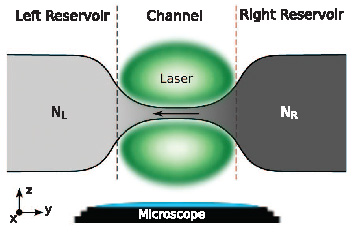 From "Conduction of Ultracold Fermions Through a Mesoscopic Channel", J-P. Brantut et al., Science 337, 1069 (2012). |
2. Out-of-equilibrium dynamics of quantum fluids
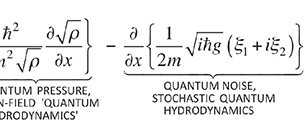
The project aims to develop theoretical tools to model and understand out-of-equilibrium behaviour of quantum fluids. Such fluids are formed in interacting many-particle systems at ultra-low temperatures, and understanding how these complex systems evolve dynamically when driven out of equilibrium remains a grand-challenge of modern quantum physics. The project intends to study the intriguing dynamical properties of quantum fluids formed by ultra-cold atomic gases, in particular, by atomic Bose and Fermi gases in one-dimensional (1D) waveguides. In such 1D waveguides, and more generally in systems of reduced dimensionality, the effects of quantum and thermal fluctuations are enhanced, compared to three-dimensional systems. As such, theoretical modelling of these systems confronts the challenges of quantum many-body physics heads on. Systems of reduced dimensionality are expected to play an increasingly important role in future quantum technologies, with its ever evolving trend in miniaturisation of electronic devices and precision measurement instruments. The expected outcomes of the project are the knowledge and theoretical tools required to underpin advances in quantum engineering applications, such as the design of quantum heat engines, the control of heat conduction in quantum nanowires and carbon nanotubes, and the fabrication of new energy-efficient materials. Specific sub-projects include:
|
 |
3. Macroscopic entanglement and Bell inequality tests with ultracold atoms
The project addresses an open fundamental question in physics of how quantum mechanics applies to systems of mesoscopic and macroscopic sizes. The project will provide theoretical guidance to Australia’s research effort to experimentally demonstrate - for the first time - quantum entanglement between large, spatially separated ensembles of ultracold atoms. Apart from being of quintessential importance to validating some of the foundational principles of quantum mechanics in new realms, controlled generation of large-scale entangled systems is important for harnessing such systems for the development of future quantum devices, as well as for enabling new insights into the unification of quantum theory with gravity. |
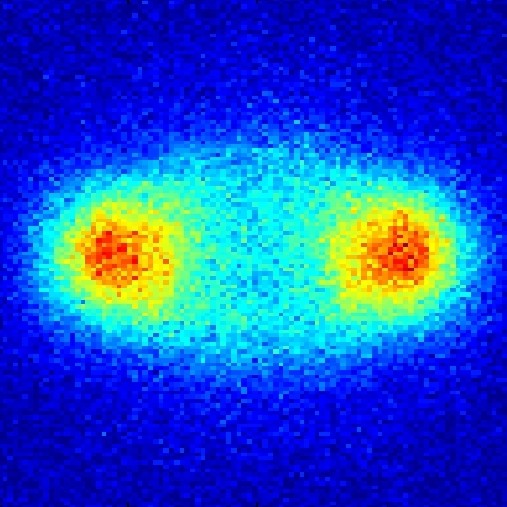 See a related work "Einstein-Podolsky-Rosen correlations via dissociation of a molecular Bose-Einstein condensate" by K. V. Kheruntsyan et al., Phys. Rev. Lett. 95, 150405 (2005). |
- Australian and New Zealand PhD students. We are looking for expressions of interest for highly-motivated domestic students from Australia and NZ*. To be competitive for an APA/UQ domestic scholarship, you will need to have/will get 1st-class honours. For Oz/NZ students we hold Postgrad Info Days for two days in September.
- International PhD students. We are looking for expressions of interest for highly-motivated international students*. To be competitive for an IPRS/UQ international scholarship (to help fund tuition fees and living costs), a Masters degree is generally required before application, along with at least one refereed journal publication accepted for publication, and English proficiency IELTS test overall score of at least 6.5. Further informations can be found here and here.
- Honours students. We have a range of projects that are suitable for honours. You can even trial a research project in the summer between your 3rd/4th years, giving you a head-start on your honours year.
- UQ Summer Vacation research scholars. We invite applicants to apply for a UQ summer vacation research scholarship to stay/visit us at UQ for a summer to get a taste of research in south-east Queensland.
- ASPinS research students. You can get involved in research throughout your undergraduate degree.
*) You should approach your prospective supervisor at least a month ahead of any advertised internal UQ School of Maths/Physics deadlines which may be earlier than the advertised UQ Graduate Office/UQ Research Office deadlines.
- Seeing you publish early in your PhD candidature will be one of my priorities.