
- home
- research
- publications
- PhD projects
- teaching
- links
Research |
Current and recently funded research projects
|
 |
 |
Most significant contributions to the research field
|
A/Prof Kheruntsyan is recognised internationally for his pioneering contributions in theoretical quantum atom optics within the field of degenerate quantum gases, most notably: (i) in the theory of coherently coupled atomic-molecular Bose-Einstein condensates, (ii) theory of atom-atom correlations and thermodynamics of one-dimensional (1D) Bose gases, and (iii) foundational tests of quantum mechanical correlations and entanglement. His work has often inspired breakthrough experiments in the leading laboratories worldwide and influenced subsequent trends in theory. More specifically, Kheruntsyan’s most significant contributions are:
1. THEORY OF MOLECULAR BOSE-EINSTEIN CONDENSATES.
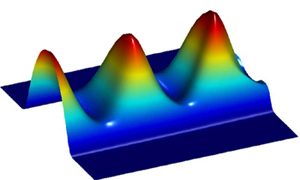
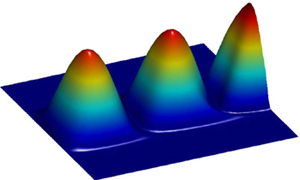
In 1998 Kheruntsyan (with Drummond and He) introduced a new field-theoretic model for the description of coherently coupled atomic and molecular Bose-Einstein condensates (BECs) [Phys. Rev. Lett. 81, 3055 (1998)]. The work was subsequently extended to describe a new mechanism for the formation of a BEC of molecular dimers using coherent Raman photoassociation of an atomic BEC [Phys. Rev. Lett. 84, 5029 (2000)]. Previous descriptions of the formation of diatomic molecules from the underlying two-body interactions were based on rate equations. In contrast, Kheruntsyan’s work predicted the possibility of coherent, matter-wave interactions in which the atoms and molecules couple as entire condensates. This implies non-Arrhenius chemical kinetics or “superchemistry”, in which the chemical reaction rates are Bose-enhanced rather than suppressed as the temperature is reduced.
This groundbreaking proposal led to a new paradigm of ultracold "superchemistry" and inspired the development of novel approaches to the creation of molecular condensates from atomic condensates. In particular, extension of this work to include fermionic atoms led to the theory of resonant superfluidity with magnetically tunable Feshbach resonance molecules (the so-called “two-channel model”) [see, e.g., K. V. Kheruntsyan and P. D. Drummond, Phys. Rev. A 61, 063816 (2000), P. D. Drummond and K. V. Kheruntsyan, Phys. Rev. A 70, 033609 (2004), M. Holland et al., Phys. Rev. Lett. 87, 120406 (2001); E. Timmermans et al., Phys. Phys. Lett. A 285, 228 (2001)]. Parallel experimental developments led to the production of molecular BECs in more than 12 laboratories worldwide. Furthermore, the theory of resonant superfluidity helped to solve a long-standing problem from condensed matter physics - “the BCS-BEC crossover” problem, which pertains to the understanding of the nature of the transition from the Bardeen–Cooper–Schrieffer (BCS) to Bose–Einstein condensate superfluidity.
This was an early example of new interdisciplinary links of cold atom physics with other sub-fields of physics. The following quote from page 72 of the 2007 Report of the Committee on Atomic, Molecular, and Optical Physics of the US National Academies (The National Academies Press, Washington, 2007) is an indirect reference to Kheruntsyan’s contribution:
While experimental breakthroughs constantly challenge theorists, the reverse is also true, with theorists suggesting new experimental paths and novel ways to reach exciting regimes where new physics can be explored. For example, the possibility of using Feshbach resonances to achieve new regimes of ultracold physics was suggested by theorists. This proposal led to the creation of molecular condensates and opened the way to one of the most exciting recent discoveries in AMO physics: observation of the crossover between Bose condensation and Cooper pairing of fermions. As a result, there is a new link between atomic and condensed matter physics.
2. THEORY OF ATOM-ATOM CORRELATIONS AND THERMODYNAMICS OF 1D BOSE GASES.
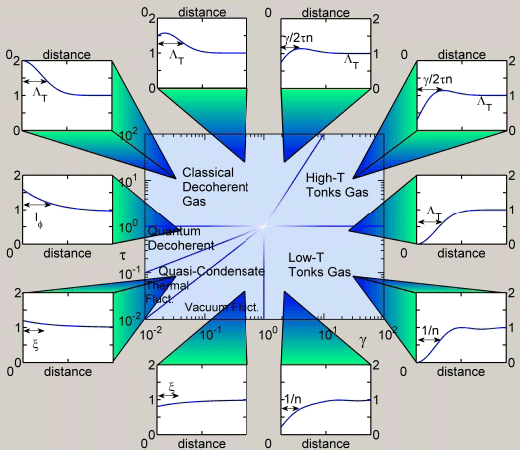
In 2003, Kheruntsyan (with Gangardt, Drummond, and Shlyapnikov) produced the world-first exact calculation of atom-atom pair correlations in a 1D Bose gas [Phys. Rev. Lett. 91, 040403 (2003)]. The 1D Bose gas is of fundamental importance to quantum many-body physics as the underlying theoretical model belongs to an important class of exactly integrable models. By calculating the atom-atom correlation functions for arbitrary interaction strengths and temperatures, Kheruntsyan and co-workers were able to map out, for the first time, the complete phase diagram of the system and to propose simple correlation measurements that could test their theoretical predictions experimentally. These predictions were confirmed in 2004 in the NIST group of Nobel laureate W. Phillips and and in 2005 in Weiss’s group at Pennsylvania State University.
In 2008, Kheruntsyan and the experimental group of N. van Druten (University of Amsterdam) published another high-impact paper on the thermodynamic properties of 1D Bose gases created on an atom chip [Phys. Rev. Lett. 100, 090402 (2008)]. The team has succeeded in comparing the temperature and atom number density of the 1D quantum gas to the exact theory developed by C.N. Yang (Nobel 1957) and C.P. Yang back in 1969. Further insights into thermodynamic properties of 1D Bose gases came through Kheruntsyan’s contribution to the interpretation of experimental measurements of density fluctuations [Phys. Rev. Lett. 105, 230402 (2010), Phys. Rev. Lett. 106, 230405 (2011)] performed in Isabelle Bouchoule’s lab at the Institut d’Optique of France. This series of works probed one of cornerstone theorems of statistical mechanics – the fluctuation-dissipation theorem, in addition to proposing a new (higher-order) version of the theorem based on the measurements of the third-order moment of density fluctuations. The experimental and theoretical methods developed in these papers for measuring and describing atom-number fluctuations have now become a ‘must-have’ tool in many laboratories around the world, studying the phase diagrams of other important ultracold atom systems.
Understanding of the physics of 1D Bose gases and atom-atom correlations developed is an important step towards the design of atomic waveguides and atom interferometers operating in low-dimensional environments, since the strength of these correlations determine the ultimate operating limits of such devices.
3. FOUNDATIONAL TESTS OF QUANTUM MECHANICAL CORRELATIONS AND ENTANGLEMENT.
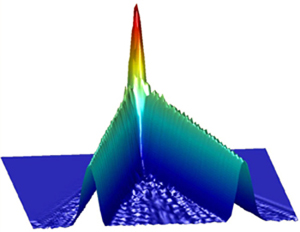
Pair correlated or 'twin' atom-laser beams resulting from a quantum dynamical simulation of the process of coherent dissociation of a BEC of molecular dimers [Phys. Rev. A 66, 031602(R) (2002)].
In the area of fundamental tests of quantum mechanical entanglement, Kheruntsyan (with Olsen and Drummond) has made a pioneering proposal for demonstrating the famous Einstein-Podolsky-Rosen (EPR) paradox using correlated atom-laser beams produced via coherent dissociation of a molecular condensate [Phys. Rev. Lett. 95, 150405 (2005)]. This process is the atom-optics analog of parametric down-conversion with photons, which played a pivotal role in the advancement of quantum optics in the 1980s and led to the modern understanding of foundational principles of quantum mechanics with photons.
Kheruntsyan has also established research collaboration with a world-renowned experimental group of Alain Aspect and Chris Westbrook (Institut d’Optique, France) aiming at an experimental demonstration of EPR entanglement and Bell inequality violation in a related ultracold atom system – colliding metastable helium condensates. To this end, the team has reported an observation and characterisation of two important precursors of such entanglement – reduction of atom number fluctuations below the Poissonian level [Phys. Rev. Lett. 105, 190402 (2010)] and violation of the classical Cauchy-Schwartz inequality [Phys. Rev. Lett. 108, 260401 (2012)] (see also a Viewpoint Commentary in Physics 5, 70 (2012)). Kheruntsyan’s most recent work in this area include novel theoretical proposals for demonstrating an atomic analog of the celebrated Hong-Ou-Mandel effect [Nature Communications 5, 3752 (2014)] and violating a motional-state Bell inequality with ultracold atoms [Phys. Rev. A 91, 052114 (2015)].
4. FERMIONIC QUANTUM-ATOM OPTICS.
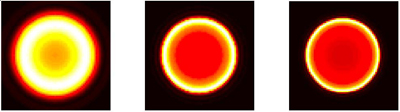
This is the first theoretical model of dissociation of a molecular Bose-Einstein condensate into correlated fermionic atoms [Phys. Rev. Lett. 96, 110401 (2006)], which represents the fermionic analog of optical parametric down-conversion. The work outlines a new paradigm of fermionic quantum-atom optics and extends the field of quantum-atom optics from bosonic (integer spin) to fermionic (half-integer spin) atoms. Indeed, while quantum-atom optics was initially established as a natural extension of ideas from quantum optics with photons (which are also bosons), a direct application of these ideas to fermionic atoms had an intriguing twist: the underlying quantum statistics were different. As a result, the analogies with quantum optics and the implications for possible future applications were less straightforward. Kheruntsyan’s work showed how to create correlated states of fermionic atoms with suppressed (‘squeezed’) relative number fluctuations. Pair-correlated atoms have been produced and detected in Jin’s laboratory at JILA (Boulder, USA) using dissociation of a BEC of potassium molecules, in agreement with Kheruntsyan’s predictions.
Possible applications of squeezed states of ultracold atomic gases lie in the design of atom interferometers for precision measurements and new fundamental tests of quantum theory.
5. STOCHASTIC PHASE-SPACE METHODS FOR SIMULATING S QUANTUM MANY-BODY DYNAMICS.
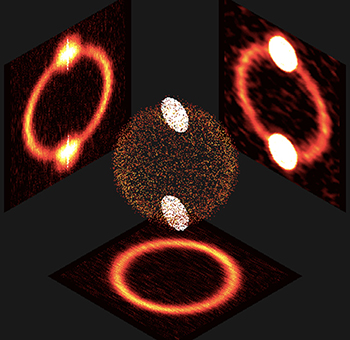
Kheruntsyan is an internationally recognised expert in using stochastic phase-space methods for simulating the quantum dynamics of interacting Bose-Einstein condensates. He was the first to perform ab initio simulations of coherent dissociation of molecular condensates [Phys. Rev. A 66, 031602(R) (2002); Phys. Rev. Lett. 95, 150405 (2005); Phys. Rev. A 74, 033620 (2006)] and to provide the first accurate quantitative models of the experiments on collisions of metastable helium condensates [New J. Phys. 10, 045021 (2008), Phys. Rev. A 79, 021606(R) (2009)] using the so-called positive-P phase space representation. The condensate collision simulations performed by Kheruntsyan in Ref. [New J. Phys. 10, 045021 (2008)] involved N=100,000 helium atoms and M=4200x40x40=6,720,000 lattice modes, which corresponds to a Hilbert space of dimension D=MN≈10700,000. This is one of the largest Hilbert spaces ever treated in an exact quantum dynamical simulation and represents a tour-de-force of computational physics.
Kheruntsyan is also a co-inventor (with P. D. Drummond and P. Deuar) of two new theoretical approaches to many-body simulations: (i) the ‘stochastic gauge’ approach [Phys. Rev. Lett. 92, 040405 (2004)] for studying equilibrium properties of interacting many-body systems using ‘imaginary-time’ evolution in phase space, and (ii) the stochastic Bogoliubov approach [Phys. Rev. Lett. 104, 150402 (2010), Phys. Rev. Lett. 108, 260401 (2012)] for dynamical simulations using the linearized treatment of quantum fluctuations [Phys. Rev. Lett. 105, 190402 (2010)), Nature Communications 5, 3752 (2014), Phys. Rev. A 90, 033613 (2014), Phys. Rev. A 91, 052114 (2015)], which is an alternative to the standard (but often numerically intractable) Bogoliubov-de Genes approach.